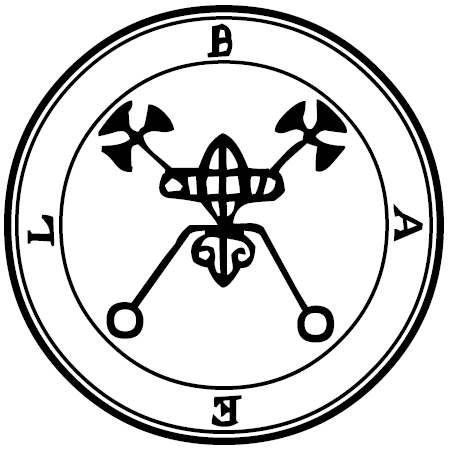
§ Introduction
Bael is traditionally recorded as the first spirit in the Ars Goetia and is given the rank of King. His placement at the top of the list helped make him one of the most referenced Goetic names in later demonology. In grimoire culture, "first" often implies not just sequence, but prestige: Bael reads like an opening statement about authority, secrecy, and command.
§ How to Work With Bael's Sigil (Educational Overview)
The Seal of Bael can be used in various symbolic and meditative practices:
Meditation Focus
Place the sigil in your line of sight during meditation sessions focused on discretion, strategic thinking, or personal boundaries. Many practitioners report using Bael's seal when they need to cultivate patience or think through complex situations without external pressure.
Artistic Study
The geometric elements of Bael's seal make it a subject for artistic exploration. Drawing or recreating the sigil by hand is considered by some traditions to be a way of internalizing its symbolic meanings.
Privacy Talisman
Historically, practitioners would carry printed or drawn sigils as personal talismans. In modern contexts, this might translate to keeping the image on your phone, in a journal, or as a piece of personal art—a symbolic reminder of your commitment to maintaining healthy boundaries.
Altar Placement
In personal spiritual practice spaces, Bael's sigil might be placed in the eastern section of an altar (corresponding to his traditional directional association), particularly when working on projects requiring careful planning or discretion.
Journal Prompts
Some people use Bael's themes as meditation prompts: "Where in my life do I need better boundaries?" "What situations require me to be more strategic?" "When is visibility helpful vs. when should I stay under the radar?"
Note: These are educational descriptions of how people have historically and currently engage with grimoire symbolism. Your personal approach should align with your own beliefs, traditions, and comfort level.
§ Bael vs. Ba'al: The Ancient Connection Explained
One of the most frequently asked questions about Bael concerns his relationship to the ancient Semitic deity Ba'al (also spelled Baal). While the names are clearly related, the entities they describe come from very different historical and cultural contexts.
Ba'al in Ancient Religion
In Canaanite, Phoenician, and other ancient Near Eastern cultures, "Ba'al" (meaning "lord" or "master") was a title applied to various storm and fertility gods. The most famous was Hadad, often called Ba'al Hadad, who controlled rain, thunder, and agricultural abundance. Ba'al worship was widespread across the ancient Levant for over a millennium.
The Christian Reframing
When medieval Christian grimoire writers compiled their demon catalogs, they frequently drew names from pre-Christian religious traditions. Ba'al—mentioned in the Hebrew Bible as a rival to Yahweh—became prime material for this transformation. The ancient storm god was recast as "Bael," the first demon in the Goetic hierarchy.
What Changed in Translation
The shift from Ba'al (ancient deity) to Bael (grimoire spirit) involved significant reinterpretation:
- Original focus: Agricultural fertility, storms, seasonal cycles
- Goetic reinterpretation: Invisibility, cunning, strategic wisdom
- From public worship to private ritual magic
- From temple practices to individual ceremonial work
Modern Scholarly View
Contemporary religious scholars generally treat these as separate phenomena: Ba'al represents ancient polytheistic religion, while Bael belongs to medieval Christian demonology. The connection is etymological and polemical rather than theological—Bael is less a "demonized Ba'al" and more a literary character borrowing an ancient name for gravitas.
Why This Matters
Understanding this distinction helps contextualize grimoire material. You're not working with ancient Canaanite religion when you study Bael—you're engaging with early modern European occultism that used ancient names as symbolic building blocks. The Bael of the Ars Goetia is a 17th-century European construction, however much it echoes older traditions.
For practitioners, this layered history can be approached as added depth: Bael carries both his grimoire attributions (invisibility, strategy) and echoes of ancient storm-god power (authority, natural force). Some modern magicians intentionally draw on both aspects; others focus solely on the Goetic profile.
§ Bael in Modern Fiction, Games & Entertainment
Bael's status as the first Goetic spirit has made him a recurring figure in popular culture, though portrayals often stray far from the original grimoire descriptions:
Video Games
- Castlevania Series: Bael appears as a boss character, often depicted as a monstrous toad-like creature (emphasizing one aspect of his traditional three-headed form)
- Dungeons & Dragons / Pathfinder: Various interpretations across different editions, sometimes conflated with Baalzebul/Beelzebub
- Shin Megami Tensei / Persona: Featured in several games in this demon-collecting JRPG series
- Diablo Series: References to Baal (often merging the ancient deity and grimoire demon)
Television & Film
- Supernatural: Bael appears in the show's extensive demon mythology
- Grimm: References Goetic demons including variations on Bael
- Constantine: John Constantine's world includes Goetic references
- Various horror films use "Bael/Baal" as shorthand for ancient evil
Literature
- Occult fiction frequently references the Ars Goetia hierarchy
- Urban fantasy often includes Bael as a power player in demon politics
- Historical fiction about Renaissance magic may reference period grimoires
Common Misrepresentations
Popular culture tends to:
- Amplify the "evil demon" angle while ignoring the strategic wisdom aspect
- Conflate Bael with Beelzebub or other "B" demons
- Ignore the invisibility/concealment themes in favor of more dramatic powers
- Depict him as purely malevolent rather than the neutral/instrumental force described in grimoires
Why The Original Matters
If you're interested in the historical grimoire tradition, it's worth distinguishing between entertainment portrayals and the actual textual descriptions. The Goetic Bael is less "monstrous villain" and more "teacher of useful skills"—a spirit offering specific forms of knowledge rather than pure destruction.
That said, creative reinterpretations have their own value. Modern fiction keeps these old names alive and introduces new audiences to grimoire traditions, even if the details shift in translation.
§ Frequently Asked Questions About Bael (Ars Goetia)
How do you pronounce Bael?
The most common pronunciations are "BAY-el" (like "bail") or "BAHL" (rhyming with "ball"). Historical texts don't provide pronunciation guides, so modern practitioners use whichever feels most natural. There's no single "correct" pronunciation—grimoire names have been pronounced differently across centuries and languages.
Is Bael dangerous to work with?
Historical grimoire traditions emphasize protective measures when working with any Goetic spirit, Bael included. The texts themselves don't single out Bael as particularly dangerous—in fact, as a King rather than a chaotic spirit, he's traditionally described as more orderly and easier to approach. That said, any serious spiritual or magical work should be undertaken with appropriate knowledge, preparation, and respect. Modern practitioners often report Bael as one of the more straightforward Goetic entities to work with symbolically.
Can Bael really make you invisible?
The historical grimoire claim that Bael grants "invisibility" is almost universally interpreted symbolically by modern readers. This likely refers to social invisibility—the ability to go unnoticed, maintain privacy, move through situations without drawing attention, or keep one's affairs discrete. Think of it as the opposite of being in the spotlight: useful for anyone who needs to work behind the scenes, protect their privacy, or avoid unwanted scrutiny. Physical invisibility remains in the realm of fantasy and folklore.
What's the difference between Bael and Baal?
"Bael" (grimoire demon) and "Ba'al" (ancient deity) share etymological roots but represent different traditions. Ba'al was a title for ancient Near Eastern storm and fertility gods, particularly in Canaanite religion. Bael is a character in medieval Christian grimoires who borrowed that ancient name. They're historically connected but functionally separate: one belongs to ancient polytheism, the other to Renaissance occultism. See our detailed comparison section above for more.
Why is Bael listed first in the Ars Goetia?
The ordering of Goetic spirits has been debated by scholars. Some suggest it follows a hierarchy of power or prestige, with Kings listed before Dukes and Princes. Others think the ordering reflects earlier source materials that compilers drew from. Bael's first position has made him particularly well-known, but it does not necessarily mean he holds the highest rank, just that he opens the catalog. His attributes (authority, strategic wisdom) make him a fitting introduction to the system.
What spirits work well with Bael?
Practitioners sometimes combine work with multiple spirits whose attributes complement each other. Spirits often paired with Bael include:
- Paimon: For combining strategic invisibility with knowledge acquisition
- Beleth: When influence and discretion need to work together
- Purson: For discovering hidden information while remaining unnoticed yourself
These combinations are based on logical overlaps in traditional attributions rather than explicit grimoire instructions.
Do I need experience to work with Bael?
Many practitioners consider Bael relatively accessible for beginners interested in Goetic study, precisely because his attributes (strategy, discretion) are practical and non-chaotic. However, any grimoire work benefits from:
- Understanding of basic protective practices in your tradition
- Clear intentions and respectful approach
- Patience and realistic expectations
- Studying multiple sources, not just one grimoire
Starting with meditation on Bael's sigil and themes (rather than formal evocation) is a common beginner approach.
Where can I find Bael's original grimoire description?
The primary source is the Ars Goetia, part of the Lesser Key of Solomon (Lemegeton). Multiple versions exist from the 17th century onward. Earlier mentions appear in Johann Weyer's Pseudomonarchia Daemonum (1577). Modern editions and translations are widely available, including free public-domain versions online. We recommend comparing multiple translations to get a fuller picture, as wording varies.
Is working with Bael compatible with [my religion]?
This is a personal question each individual must answer based on their own beliefs and religious community. Historically, grimoire magic emerged from Christian contexts but often sat uneasily with church doctrine. Modern practitioners come from diverse backgrounds: some see it as psychological symbolism, others as cultural history, some as literal spirit work within their own traditions. There's no universal answer—only what aligns with your personal path and conscience.
§ Related Goetic Spirits: If You're Interested in Bael...
If Bael's themes of invisibility, strategy, and authority resonate with you, you might also be interested in these related Goetic spirits:
Spirits with Similar Strategic Attributes
Paimon (King #9): While Bael offers invisibility and discretion, Paimon specializes in knowledge acquisition and understanding hidden sciences. Together, they represent "know more while being seen less"—a powerful combination for researchers, strategists, and anyone navigating complex information landscapes.
Beleth (King #13): Where Bael teaches you to move unseen, Beleth helps you influence others and command respect. The pairing addresses both stealth and impact: knowing when to stay hidden and when to make your presence felt.
Vine (King #45): Bael conceals; Vine reveals. Vine is traditionally called upon to discover hidden things, break down obstacles, and expose secrets. Working with both spirits addresses the full spectrum of hidden information: protecting your own while uncovering others'.
Purson (King #20): Another spirit associated with discovering hidden knowledge and divination. While Bael helps you remain undetected, Purson helps you detect what others hide. Complementary rather than overlapping.
Other First-Ranked Spirits Worth Exploring
Since Bael is the first King, you might be interested in the first spirit of other ranks:
- Buer (President #10): First Great President listed, associated with natural philosophy and understanding
- Barbatos (Duke #8): First Duke, connected with animal communication and divination
These "first" spirits often receive special attention from practitioners interested in grimoire hierarchies.
Learning Path Through the Goetia
Many practitioners work through the Goetic spirits systematically rather than randomly:
- Start with Bael (invisibility, strategy) - foundation in discretion
- Move to Paimon (knowledge) - build understanding
- Explore Beleth (influence) - learn to act on knowledge
- Work with Vine (revealing) - complete the cycle of hidden/revealed
This creates a progression: learn to protect yourself → acquire knowledge → use it strategically → overcome obstacles.
Note: These are educational suggestions based on traditional attributions and common practitioner approaches. Your own path through grimoire study should follow your interests, needs, and intuition rather than prescribed orders.
§ Rank and Authority
Rank: King
Legions: commonly given as 66 in the Goetia tradition
In demonological catalogs, legions function like a symbolic bureaucracy—an attempt to describe spiritual power using the language of states, armies, and administration. The name Bael is commonly linked in historical scholarship to the broader family of Ba'al / Baal titles in the ancient Near East, where "lord/master" could attach to multiple local deities.
§ Appearance (Traditional Description)
Goetic descriptions give Bael a famously composite look: three faces/heads—often described as cat, toad, and human—with a harsh or rough voice. Whether read literally or symbolically, the image suggests a being that combines stealth (cat), liminal transformation (toad), and speech/intellect (human).
§ Powers and Attributions (Historical Claims)
Classical Goetia summaries credit Bael with:
- The grimoire describes Bael as granting invisibility
- The text attributes to him the power of increasing wisdom or "subtlety" (period phrasing)
Modern readers often interpret "invisibility" as social or perceptual concealment—moving unnoticed, staying off others' radar—rather than a literal physical phenomenon.
§ Practical Use as Cultural Context (Non-Instructional)
Historically, Bael represents two enduring human desires: privacy and advantage. The grimoire frame packages these desires as an external power with rules, ranks, and a recognizable "signature." As a cultural artifact, Bael is useful for studying how early modern Europe imagined secrecy as something negotiable—a symbolic interpretation of authority and concealment in the human psyche.
Why Bael Is Associated With "Invisibility" (Ars Goetia Tradition) — Symbolic Reading
The Ars Goetia traditionally describes Bael as conferring the power of invisibility upon those who work with his seal. In the context of 17th-century grimoire culture, "invisibility" was often understood as the ability to move through society unnoticed—a valuable skill for anyone navigating political, social, or personal dangers.
Modern readers typically interpret this attribution symbolically: Bael's "invisibility" represents the wisdom of discretion, timing, and strategic silence. Rather than literal vanishing, it suggests knowing when not to speak, how to avoid unnecessary conflicts, and the art of preserving one's privacy in an intrusive world.
Presented here as historical and symbolic reference, Bael's invisibility theme resonates with anyone who values the ability to control their own visibility and choose when—and how—to be seen.
Why Bael Is Linked With Concealment & Privacy — Historical Context
In the historical grimoire tradition, Bael is associated with concealment—the ability to keep secrets, protect personal information, and maintain boundaries. This attribution likely reflects the concerns of early modern practitioners who faced real dangers from exposure: religious persecution, political intrigue, and social ostracism.
The name Bael itself may derive from the Semitic Ba'al, suggesting a much older pedigree than the medieval grimoires. Some scholars interpret Bael as a "demonized" version of ancient storm and fertility gods, recast by Christian writers as an infernal spirit. This cultural layering adds depth to his concealment theme: even his origins are hidden beneath centuries of reinterpretation.
Often interpreted today as symbolic wisdom for boundary-setting and privacy protection, Bael's concealment attributes speak to a universal human need: the right to control what others know about us.
Bael as a King: Strategy, Authority & Restraint — Traditional Meaning (Non-Instructional)
Bael holds the rank of King in the Goetic hierarchy—the first King listed, commanding 66 legions. In grimoire symbolism, the title "King" implies not just power but measured authority: the wisdom to rule rather than merely dominate. This distinguishes Bael from more chaotic or impulsive spirits in the catalog.
The association with strategy and restraint reflects a particular vision of leadership: one that values patience, timing, and the ability to act decisively only when necessary. Traditionally described as granting "subtlety" and wisdom, Bael represents the kind of intelligence that wins through preparation rather than brute force.
Presented here as historical and symbolic reference, Bael's "King" status offers a meditation on authority exercised with restraint—a model of power that keeps its cards close and strikes only at the right moment.
§ Short Sources (Pre-1900)
- Johann Weyer — Pseudomonarchia Daemonum (1577)
- Reginald Scot — The Discoverie of Witchcraft (1584)
- Lemegeton Clavicula Salomonis — Ars Goetia (17th-century manuscript tradition; pre-1900 transmission)
- Jacques Collin de Plancy — Dictionnaire Infernal (1818; illustrated ed. 1863)
This article is a historical summary of public-domain grimoire material. It does not provide ritual instructions or claim supernatural efficacy.
Quick Reference
Number:
1st Spirit
Rank:
King
Legions:
66
Appearance:
Three heads (cat, toad, human)
Historical Powers:
Invisibility (traditionally), wisdom, strategic thinking