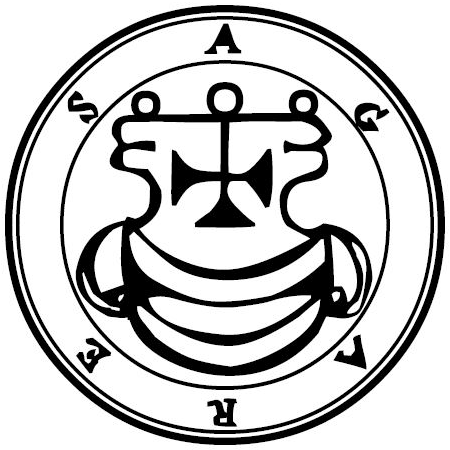
§ Introduction
Agares sits near the top of the Goetic catalog, and his profile blends the practical (languages, messages) with the surreal (earth trembling, crocodile imagery). In grimoire culture, this mash-up often signals an archetype: communication as a force that moves people, sometimes faster than rules can keep up.
§ How to Work With Agares's Sigil (Educational Overview)
People who engage with grimoire symbolism often use Agares's seal as a visual focus for themes like learning, translation, or navigating noisy social environments. Common non-ritual approaches include:
- Meditation Focus: Study the seal while journaling about communication habits, rumor dynamics, and social boundaries.
- Artistic Study: Re-drawing the seal as a design exercise, emphasizing attention and pattern recognition.
- Reflection Prompt: "Where is fast communication helping me—and where is it destabilizing me?"
Note: This is presented as cultural/historical description and symbolic reflection, not as a promise of effects.
Why Agares Is Associated With "Languages" (Ars Goetia Tradition) — Symbolic Reading
The Ars Goetia traditionally describes Agares as teaching languages quickly. In the context of 17th-century grimoire culture, rapid language acquisition was a valuable skill for diplomats, scholars, and anyone navigating Europe's polyglot courts and trade networks.
Modern readers typically interpret this attribution symbolically: Agares's "language" theme represents the wisdom of pattern recognition, rapid learning, and communication fluency. Rather than magical fluency, it suggests the cognitive skills needed to pick up new systems—whether linguistic, technical, or social.
Presented here as historical and symbolic reference, Agares's language theme resonates with anyone working to master new communication tools or decode unfamiliar social contexts.
Why Agares Is Linked With Rumors & Narrative Movement — Historical Context
In the historical grimoire tradition, Agares is associated with rumors and the spread of information—the ability to influence what people say and believe. This attribution likely reflects early modern anxieties about reputation: in tight-knit communities, a rumor could destroy a career, a marriage, or a life.
The figure of Agares riding a crocodile—an animal that lurks unseen before striking—reinforces this theme. Rumors work the same way: invisible until they surface, and then suddenly dangerous. This cultural layering makes Agares a useful figure for studying how information becomes weaponized.
Often interpreted today as symbolic wisdom for understanding viral narratives and reputation dynamics, Agares's rumor attributes speak to a timeless concern: the power of speech to move faster than truth.
Agares and "Trembling Ground" — Instability, Upheaval & Change (Traditional Meaning)
Agares holds the rank of Duke in the Goetic hierarchy and is attributed with causing the earth to tremble or stir. Some take this literally as earthquake folklore; many modern readers treat it symbolically: instability, upheaval, the feeling that the ground beneath your plans has shifted.
The association with shifting ground reflects a particular vision of change: not gradual evolution, but sudden destabilization. Agares represents situations where what felt solid becomes uncertain—relationships, jobs, social standing, even physical safety.
Presented here as historical and symbolic reference, Agares's "trembling ground" theme offers a meditation on navigating change when the rules themselves seem to be shifting.
§ Frequently Asked Questions About Agares (Ars Goetia)
How do you pronounce Agares?
Common modern pronunciations include "AH-guh-rez" or "uh-GAIR-ez." Historical texts don't standardize pronunciation.
Is Agares "about languages" or "about rumors"?
Both show up across traditions. A clean modern read is: languages = controlled learning, rumors = uncontrolled spread—two sides of communication.
What does "stirring the earth" mean here?
Some take it literally as folklore; many modern readers treat it symbolically: instability, upheaval, shaky ground under plans.
Is this page offering ritual instructions?
No. It's a historical/symbolic summary and does not claim efficacy.
Where are the original sources?
See the "Short Sources" section below; editions vary, so comparing versions helps.
§ Rank and Authority
Rank: Duke
Legions: commonly listed as 31
Agares appears with spelling variation across manuscripts and later catalogs—normal for texts transmitted through copying, translation, and editorial cleanup over centuries.
§ Appearance (Traditional Description)
The Ars Goetia tradition describes Agares as an old man riding a crocodile, sometimes holding a hawk. Read symbolically, it's an image of experience (old man) attempting to steer something primal and volatile (crocodile)—a neat visual metaphor for trying to control information once it's in motion.
§ Powers and Attributions (Historical Claims)
Classical summaries commonly attribute to Agares:
- Teaching languages quickly
- Influencing movement/return of "runaways" (text tradition)
- Spreading rumors or shifting social narratives (later demonological framing)
- Causing trembling or "stirring" of the earth (wording varies by edition)
§ Practical Use as Cultural Context (Non-Instructional)
Agares is useful for studying early modern anxiety about speech as contagion. In small courts and tight cities, reputations were infrastructure. Rumors could trigger exile, violence, or economic collapse. Agares—whether you treat him as myth, symbol, or folklore—functions like an emblem for language that travels, and the social aftershocks that follow.
§ Short Sources (Pre-1900)
- Johann Weyer — Pseudomonarchia Daemonum (1577)
- Reginald Scot — The Discoverie of Witchcraft (1584)
- Lemegeton Clavicula Salomonis — Ars Goetia (17th-century manuscript tradition; pre-1900 transmission)
- Jacques Collin de Plancy — Dictionnaire Infernal (1818; illustrated ed. 1863)
This article is a historical summary of public-domain grimoire material. It does not provide ritual instructions or claim supernatural efficacy.
Quick Reference
Number:
2nd Spirit
Rank:
Duke
Legions:
31
Appearance:
Old man riding a crocodile (sometimes with a hawk)
Historical Powers:
Languages, rumor/narrative spread, trembling ground (wording varies)