§ Introduction
Paimon is one of the most famous Goetic kings—partly because grimoires portray him with maximum spectacle: a crowned figure, mounted on a swift beast, arriving with music, noise, and a whole entourage. In the old lists, Paimon is less "lurking horror" and more "royal visitation," associated with teaching broad knowledge—philosophy, sciences, and the hidden structure of the world.
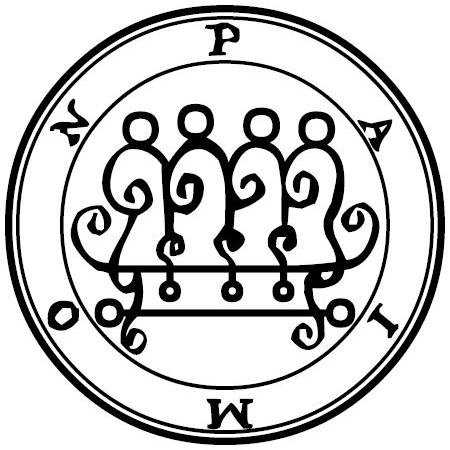
§ Paimon's Sigil as Cultural Artifact (Non-Instructional)
In the grimoire tradition, seals function as identifiers—visual signatures tied to a spirit's name inside a manuscript catalog. Today they're often studied as historical graphics, occult art motifs, or symbolic design elements. This page presents Paimon's seal as historical/symbolic reference only, without claims of efficacy.
§ Rank and Authority
Rank: Great King
Legions: 200 (the largest command in the Goetia)
In Scot's account, Paimon is described as a king notably more obedient to Lucifer than other kings. These ranks reflect spiritual bureaucracy—early modern writers explaining invisible forces using the language of courts and command.
§ Appearance (Traditional Description)
Paimon is described as appearing in a human likeness while seated on a swift animal (a dromedary), wearing a glorious crown, with an "effeminate countenance," and preceded by an audible procession (trumpets, cymbals, instruments).
Symbolic read: Crown + procession → authority that demands attention. Music + noise → charisma, persuasion, mass influence. Mounted arrival → speed, message-bearing, power-in-motion.
§ Powers and Attributions (Historical Claims)
Paimon is credited with teaching and revealing:
- Philosophy, wisdom, science, and "secret things"
- Explanations about the structure of the world (cosmic/elemental curiosity)
- The ability to grant dignities/confirmations (status, legitimacy)
- The capacity to bind resistors and provide "good familiars" (as grimoires phrase it)
Symbolic reading (modern): broad education, social elevation, systems-thinking, and ambition with very loud branding.
§ Practical Use as Cultural Context (Non-Instructional)
Historically, Paimon reads like a spirit of: broad education (the "teach me everything" archetype), social elevation (titles, recognition, legitimacy), and systems-thinking (why the world is arranged as it is). If you strip away the supernatural frame, Paimon is basically a mythic personification of ambition + knowledge + prestige—with very loud branding.
§ Frequently Asked Questions About Paimon (Ars Goetia)
How do you pronounce Paimon?
Common modern pronunciations include "PAY-mon" or "PIE-mon." Manuscripts don't standardize pronunciation.
Why is Paimon so famous?
Paimon's combination of high rank (King), large command (200 legions), spectacular arrival (music and procession), and broad knowledge portfolio makes him one of the most memorable Goetic figures.
What does Paimon teach?
The grimoire tradition attributes philosophy, sciences, secret things, and knowledge of the world's structure. Modern readers often interpret this as symbolic wisdom about learning and systems-thinking.
Does this page provide ritual instructions?
No. This is a historical/symbolic summary and does not claim supernatural efficacy.
§ Short Sources (Pre-1900)
- Johann Weyer — Pseudomonarchia Daemonum (1577)
- Reginald Scot — The Discoverie of Witchcraft (1584)
- Lemegeton Clavicula Salomonis — Ars Goetia (17th-century manuscript tradition; pre-1900 transmission)
- Jacques Collin de Plancy — Dictionnaire Infernal (1818; illustrated ed. 1863)
This article is a historical summary of public-domain grimoire material. It does not provide ritual instructions or claim supernatural efficacy.
Quick Reference
Number:
9th Spirit
Rank:
Great King
Legions:
200
Appearance:
Crowned man on dromedary with musical procession
Historical Powers:
Teaches philosophy, science, secrets; grants dignities; reveals cosmic structure