§ Introduction
Marbas is one of the most "useful-sounding" entries in the Goetia: less throne-room drama, more triage + engineering. Even his imagery supports the vibe—lion (raw force) → human (articulation and method). In the manuscript worldview, that's power becoming legible.
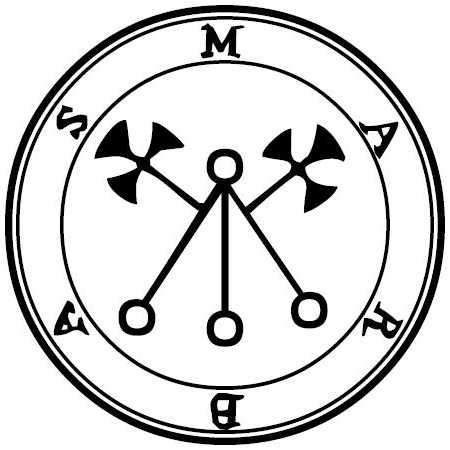
§ How to Engage With Marbas's Sigil (Educational Overview)
People who study grimoire symbolism often engage with seals as historical graphics or reflection tools. Non-ritual, non-claim approaches include:
- Design / art study: redraw the seal as a pattern exercise (attention + patience).
- Journaling prompts: "What's hidden in this situation?" "What's broken—process, boundary, habit?" "What does 'repair' look like in real terms?"
- Focus practice: use the seal as a visual anchor while thinking through a problem (like a moodboard, not a magic button).
Note: This is cultural description of how symbols are used today. No efficacy is claimed.
§ Rank and Authority
Rank: Great President
Legions: commonly given as 36
In demonological catalogs, ranks are basically spiritual bureaucracy: early modern writers explaining invisible power using very visible institutions—courts, offices, chains of command.
§ Appearance (Traditional Description)
The classic description presents Marbas as appearing first as a furious/great lion, later taking human form. Symbolically, it reads like a translation from instinct → intelligence: wild force converted into knowable answers.
§ Powers and Attributions (Historical Claims)
Traditional summaries commonly attribute to Marbas:
- Truthful answers about hidden/secret matters
- The ability to cause and cure diseases (as described in historical grimoire texts only, not medical claims)
- Knowledge in mechanical arts
- Changing forms / metamorphosis
Symbolic reading (modern): diagnosis, repair, craft knowledge, and personal change—useful metaphors, not medical or supernatural guarantees.
§ Practical Use as Cultural Context (Non-Instructional)
Marbas is a neat artifact of how people once imagined "expertise." Healing wasn't just biology; it was mystery plus method. Engineering wasn't just physics; it was craft plus secret knowledge. A spirit who "knows what's hidden," "fixes disease," and "teaches mechanics" is basically a mythic personification of technical competence—and the fear that competence can be used in morally complicated ways.
§ Frequently Asked Questions About Marbas (Ars Goetia)
How do you pronounce Marbas?
Common modern pronunciations include "MAR-bass" or "MAR-buz." Manuscripts don't standardize pronunciation.
Is Marbas really a "healer"?
The tradition attributes causing and curing diseases, but that's a historical claim within a grimoire framework—not medical fact or a promise.
Why the lion imagery?
Text tradition uses the lion → human shift; symbolically it can read as raw power becoming communicable knowledge.
Is this page offering ritual instructions?
No. This is a historical/symbolic summary and does not claim supernatural efficacy.
§ Short Sources (Pre-1900)
- Johann Weyer — Pseudomonarchia Daemonum (1577)
- Reginald Scot — The Discoverie of Witchcraft (1584)
- Lemegeton Clavicula Salomonis — Ars Goetia (17th-century manuscript tradition; pre-1900 transmission)
- Jacques Collin de Plancy — Dictionnaire Infernal (1818; illustrated ed. 1863)
This article is a historical summary of public-domain grimoire material. It does not provide ritual instructions or claim supernatural efficacy.
Quick Reference
Number:
5th Spirit
Rank:
Great President
Legions:
36
Appearance:
Lion → human form (traditional description)
Historical Powers:
hidden things, disease/health claims, mechanical arts, metamorphosis (traditional attributions)