§ Introduction
Samigina's entry has that classic grimoire flavor: education on one hand, death-and-morality reportage on the other. It's a weird combination—until you remember that in early modern Europe, learning and theology were tangled together like headphones in a pocket. Samigina reads like an archetype for "knowledge with consequences."
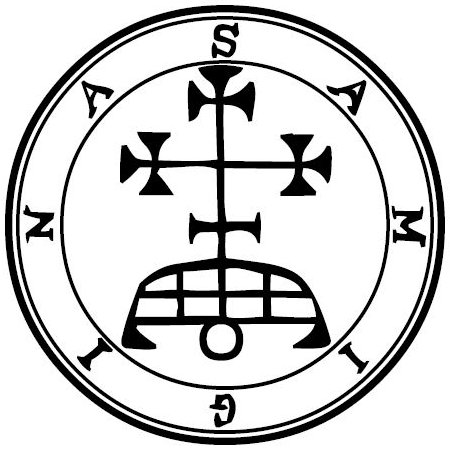
§ Samigina's Sigil as Cultural Artifact (Non-Instructional)
In the grimoire tradition, a seal functions as an identifier—a visual "name-tag" for the spirit within the catalog. Contemporary use varies (art, study, meditation, design), but this page presents the seal strictly as historical/symbolic reference, without claims of efficacy.
§ Rank and Authority
Rank: Great Marquis
Legions: commonly given as 30
Demonological ranks mirror human bureaucracy: power explained through courts, titles, and command structures.
§ Name Variants: Samigina vs. Gamigin
The Goetia manuscript tradition is full of spelling drift. Samigina is also recorded as Gamigin/Gamigm in widely circulated public-domain editions. This isn't "mystical"; it's what happens when texts travel by copying, translation, and editorial choices.
§ Appearance (Traditional Description)
A key public-domain Goetia text describes Samigina as appearing first as a little horse or ass, and then changing into human shape "at request," while speaking with a hoarse voice. Symbolically, it's an image of humble, stubborn "beast of burden" energy turning into speech and instruction—knowledge that starts awkward and becomes articulate.
§ Powers and Attributions (Historical Claims)
Classical summaries commonly attribute to Samigina:
- Teaching all liberal sciences
- Giving an "account" of dead souls who died in sin (traditional phrasing)
- Remaining in conversation until the operator is satisfied (a common Goetia motif in some editions)
Symbolic reading (modern): disciplined study, moral inquiry, memory, and the uncomfortable human drive to categorize "good outcomes" vs. "bad outcomes."
§ Practical Use as Cultural Context (Non-Instructional)
Samigina is a strong lens for how grimoires framed learning: not as neutral trivia, but as a thing tied to virtue, danger, pride, salvation, transgression. "Liberal sciences" in this setting doesn't mean modern college electives—it signals the classical academic scaffold (grammar/logic/rhetoric, etc.) that educated elites treated as power tools.
And the "dead souls" piece? That's early modern moral imagination doing what it does best: turning the unknown into a reportable bureaucracy.
§ Frequently Asked Questions About Samigina (Ars Goetia)
How do you pronounce Samigina?
Common modern pronunciations include "sah-MIH-jih-nuh" or "sam-ih-JEE-nuh." Manuscripts don't standardize pronunciation.
Is Samigina the same as Gamigin?
They're generally treated as the same Goetic entry across editions, with spelling variants reflecting transmission history.
Can Samigina really "teach the liberal sciences"?
That's a historical claim in the text tradition. Modern readers often interpret it symbolically: focus, learning systems, and intellectual discipline, not promised outcomes.
Can Samigina "speak with the dead"?
The Goetia framing is about giving "account" of certain dead souls. That should be read as folklore or a symbolic narrative rather than a reliable method for real-world afterlife facts.
Does this page provide ritual instructions?
No. This is a historical/symbolic summary and does not claim supernatural efficacy.
§ Short Sources (Pre-1900)
- Johann Weyer — Pseudomonarchia Daemonum (1577)
- Reginald Scot — The Discoverie of Witchcraft (1584)
- Lemegeton Clavicula Salomonis — Ars Goetia (17th-century manuscript tradition; pre-1900 transmission)
- Jacques Collin de Plancy — Dictionnaire Infernal (1818; illustrated ed. 1863)
This article is a historical summary of public-domain grimoire material. It does not provide ritual instructions or claim supernatural efficacy.
Quick Reference
Number:
4th Spirit
Rank:
Great Marquis
Legions:
30
Appearance:
Little horse/ass → human form; hoarse voice (traditional description)
Historical Powers:
Liberal sciences; "accounts" of certain dead souls (traditional phrasing)