§ Introduction
Amon reads like a social-engineering myth: a Marquis associated with conflict ignition and conflict resolution, plus the ability to speak to "past and to come." In grimoire logic, that's not random—it's a worldview where relationships, reputation, and timing are the real battlefield.
§ Amon's Sigil as Cultural Artifact (Non-Instructional)
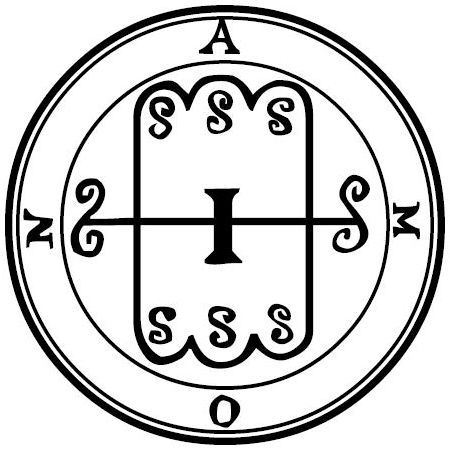
In the manuscript tradition, seals function as identifiers—visual signatures tied to named spirits inside a catalog. People engage with these designs today as historical graphics, occult art motifs, or reflection tools. This page presents Amon's seal as historical and symbolic reference, not as an efficacy claim.
§ Rank and Authority
Rank: Marquis
Legions: 40
Goetic ranks borrow the language of courts and command—an attempt to describe spiritual power as bureaucracy.
§ Appearance (Traditional Description)
The Goetia tradition gives Amon a vivid "two-form" description: a monstrous form associated with a wolf and serpent tail with fiery breath, and a humanoid form featuring a raven-like head and canine teeth (wording varies by edition). Symbolically, it's a mash-up of predation (wolf), venom/instinct (serpent), and hard intelligence (raven)—a visual metaphor for how conflict can be both animal and strategic.
§ Powers and Attributions (Historical Claims)
Classical Goetia phrasing attributes to Amon:
- Declaring "things past and to come"
- Procuring feuds
- Reconciling controversies between friends
- Governing 40 legions
Symbolic reading (modern): hindsight + foresight, escalation + de-escalation, and the ethics of influence.
§ Why Amon Is Linked With Feuds and Reconciliation (Symbolic Reading)
Amon's "double attribution" is the interesting part. In social reality, the skills that start feuds (rhetoric, leverage, timing, selective truth) are often the same skills used to end them (reframing, accountability, negotiation, face-saving exits). Read this way, Amon becomes an emblem for narrative power—the capacity to turn a relationship toward heat or toward repair.
§ Amon vs. Amun / Baal Hammon: Name Confusions, Not the Same Thing
Amon/Aamon is often conflated with older divine names (especially Amun/Amon in Egypt, and sometimes Baal Hammon in Punic/Carthaginian religion) because grimoires and later demonological catalogs frequently borrowed ancient-sounding names. Modern scholarship generally treats these as distinct cultural contexts: ancient deities belong to their own religious systems; the Goetic Amon is part of early modern European demonology. The overlap is mainly linguistic and historical transmission, not a clean "same being" continuity.
§ Practical Use as Cultural Context (Non-Instructional)
Amon is a useful artifact for studying how early modern writers imagined conflict as a force—something you could "procure," "steer," or "settle." It's also a reminder that "knowing the past and future" often means understanding incentives, patterns, and consequences: the kind of insight that can prevent fights—or win them.
§ Frequently Asked Questions About Amon (Ars Goetia)
How do you pronounce Amon/Aamon?
Common modern pronunciations include "AY-mon," "AH-mon," or "AH-ah-mon." Manuscripts don't standardize pronunciation.
Is Amon about love, conflict, or prophecy?
Text tradition links him to feuds, reconciliation, and "past and to come." Many modern readers interpret this as symbolic insight into relationship dynamics and consequences, not literal prophecy.
Why does the text describe both causing feuds and reconciling them?
That contradiction is the point: it frames Amon as influence over the whole conflict cycle—escalation and resolution.
Does this page provide ritual instructions?
No. This is a historical/symbolic summary and does not claim supernatural efficacy.
§ Short Sources (Pre-1900)
- Johann Weyer — Pseudomonarchia Daemonum (1577)
- Reginald Scot — The Discoverie of Witchcraft (1584)
- Lemegeton Clavicula Salomonis — Ars Goetia (17th-century manuscript tradition; pre-1900 transmission)
- Jacques Collin de Plancy — Dictionnaire Infernal (1818; illustrated ed. 1863)
This article is a historical summary of public-domain grimoire material. It does not provide ritual instructions or claim supernatural efficacy.
Quick Reference
Number:
7th Spirit
Rank:
Marquis
Legions:
40
Appearance:
wolf + serpent tail + fiery breath; raven-headed humanoid variant (traditional descriptions vary by edition)
Historical Powers:
"past and to come," feuds, reconciliation (traditional attributions)